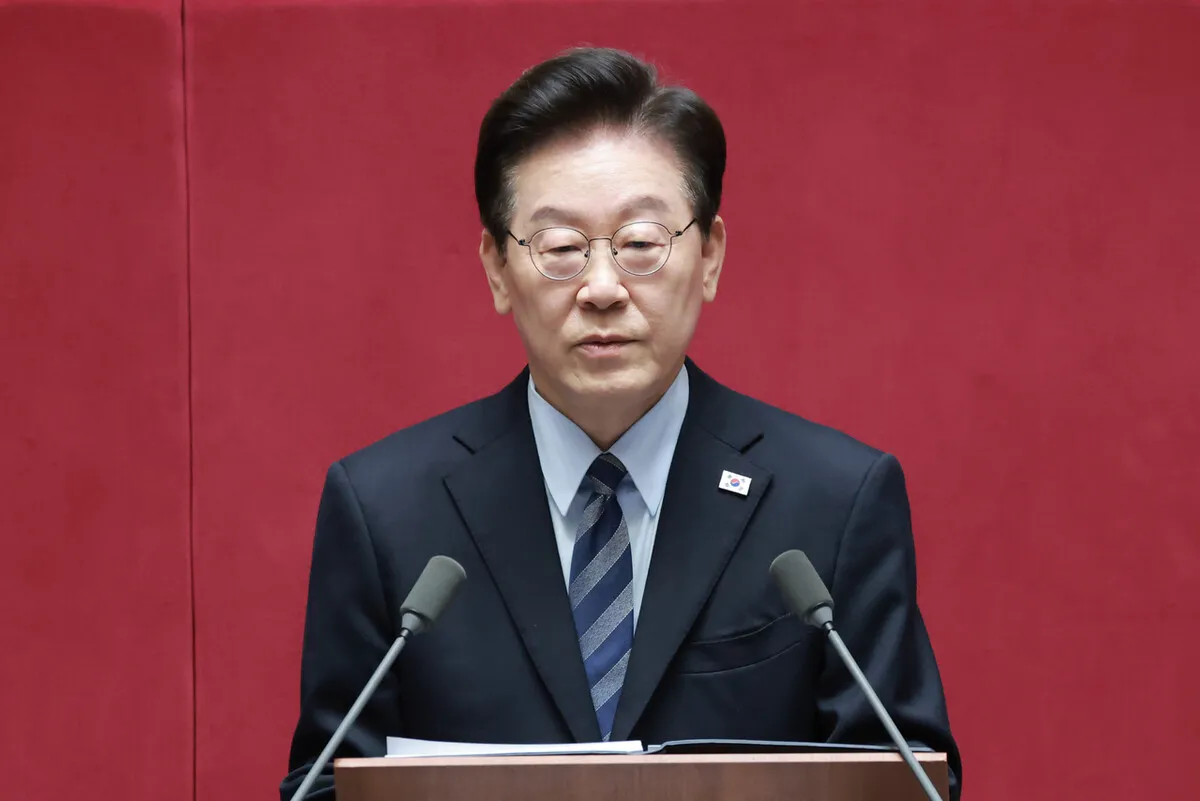
South Korean President Lee Jae-myung presented his government's 2027 budget proposal to the National Assembly on Monday, framing the spending plan around a new growth formula he calls "growth for all," according to 한겨레. In his budget address, Lee said the country must answer citizens who feel the economy has improved while their own households have not, and who ask what growth is worth if their lives do not get better.
The president said the budget was drafted on three principles: investing boldly without wasting money on inefficiency, favoring direct fiscal spending over tax expenditures, and giving preference to the regions in the name of balanced national development. 한겨레 reports that Lee used the word "growth" 36 times in the speech, and "support" and "investment" 24 times each.
Why it matters
The address sets the terms of the spending fight ahead. Lee's emphasis on spreading the gains and opportunities of growth — beyond Seoul and the capital region — signals that his government intends to sell the budget as a fairness package rather than a simple stimulus. The proposal also comes with a defense of expanded spending: Lee said the managed fiscal balance will improve from a deficit equal to 3.9 percent of GDP this year to 0.1 percent next year, which he described as the healthiest position in 20 years, and that most new government bonds will go toward retiring existing debt, leaving little net increase. 한겨레 reports that the remarks appeared aimed at opposition lawmakers who have criticized rising national debt under expansionary budgets.
Youth funding and household support
Lee said the youth budget will rise 53.5 percent from this year to 43.3 trillion won. Within that envelope, he cited an expansion of public rental housing for young people to 106,000 units, a 1 million won payment to newlywed couples, and "child-welcome" grants of up to 20 million won. 한겨레 notes the headline figure of a 54 percent increase.
Support for low-income households and other vulnerable groups was also expanded, according to the president's remarks. He cited a rise in the basic livelihood benefit to a maximum of 2.218 million won per month for a four-person household, issuance of 25.6 trillion won in local love gift certificates and 4.5 trillion won in Onnuri gift certificates, and an additional payment of up to 30,000 won per month in the basic pension for low-income seniors.
Regional balance and future industries
On balanced development, Lee said 44 central government agencies will begin a phased relocation from the capital region to Sejong starting next year. He also pointed to a 3.5 trillion won local future growth fund and full coverage of tuition at 30 regional national universities.
For future industries, the president said the government will put 21.3 trillion won — nearly double this year's figure — into three "mega-projects": semiconductors, physical artificial intelligence, and AI data centers and AI investment. He said 2 trillion won will go toward early operation of semiconductor fabrication plants in the capital region and construction of a cluster in the southwest.
The budget now goes to the National Assembly, where the opposition's response to the debt and spending figures will shape how much of the plan survives.